
Manchester County Court Records After a Jail Arrest
Every Manchester case follows one path. A person is arrested, booked, and brought to court. Manchester Police make the arrest and write the booking charge. That charge is the police side. It is an allegation, not a court ruling. The court record begins later, when a prosecutor files the formal charge. In Connecticut, that prosecutor is a State's Attorney, not a county district attorney. The filed charge can match the booking charge, or it can be amended, reduced, dropped, or replaced. The court record, not the booking sheet, is what controls the case.
The flow is simple to picture: Arrest, then Booking, then Arraignment, then Charges Filed, then Court Record. Arraignment is the first court appearance, where charges and release terms are read. Booking and custody detail sit on the jail side, so the jail inmate records page covers the roster and where someone is held, and the jail mugshots page covers booking photos. Filed charges, court dates, and case status sit in the court file. Most Manchester matters route to the Geographical Area 12 court at Manchester. Serious felonies route to Hartford Superior Court instead.
Note: The booking charge a person is held on can differ from the charge the State's Attorney later files in the court record.
From a Manchester Arrest to GA 12 Court
Most Manchester arrests land in Geographical Area 12 at Manchester. The courthouse sits at 410 Center Street, Manchester, CT 06040. The Connecticut Judicial Branch directions page says wheelchair access is through the front door and points ADA accommodation requests to the local court contact. This GA court is the local home for the bulk of arrest-driven cases. It hears the everyday criminal and motor-vehicle stream that follows a town arrest.
GA offices handle a defined band of cases. The Division of Criminal Justice says the Hartford and Manchester GA offices prosecute class C, D, and E felonies, misdemeanors, infractions, and motor-vehicle offenses. So a Manchester drunk-driving charge, a low-level theft, or a misdemeanor assault usually opens here. The docket number on the court file ties the charge to this court location. When the arrest paperwork lists GA 12 Manchester, the case record should be searched under that court first.
The Judicial Branch keeps a directions and contact page for this courthouse, useful for anyone heading to court or the clerk. To reach it, see the GA 12 Manchester court directions page.
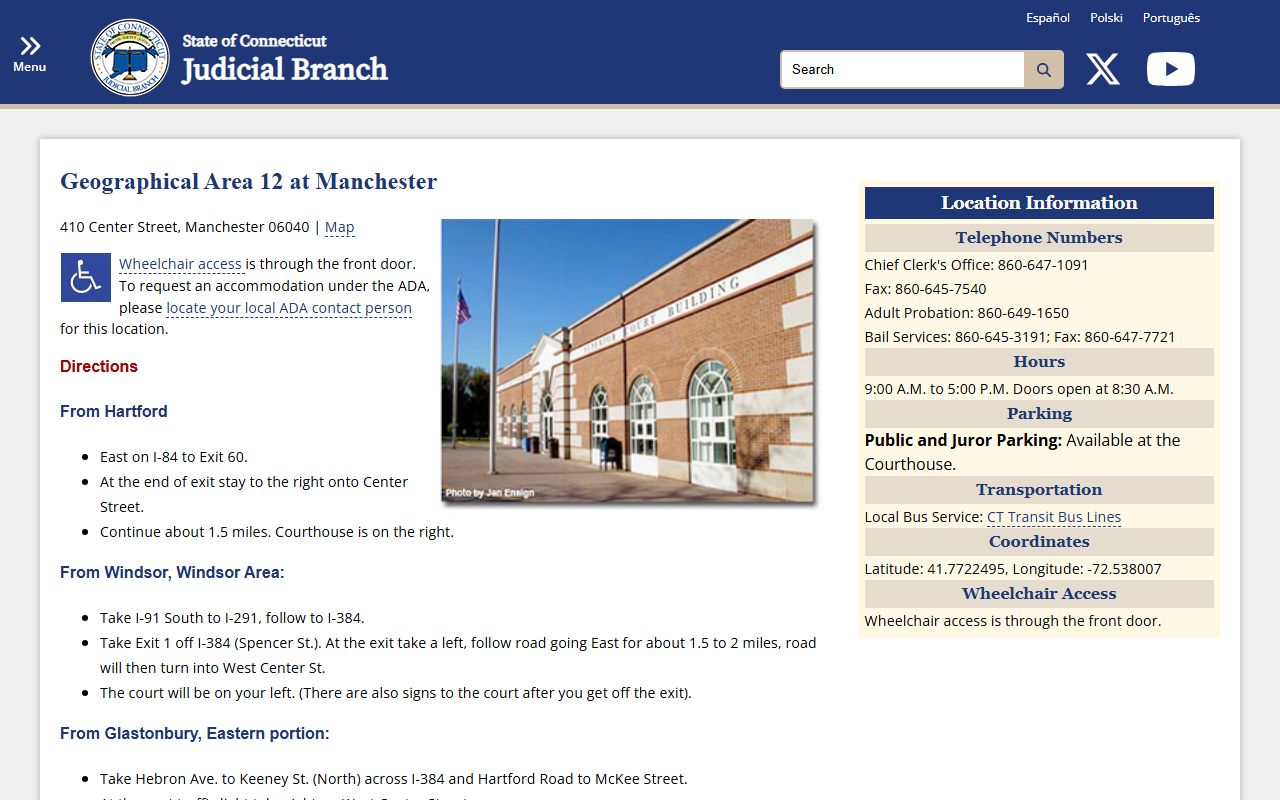
The page lists the street address and the front-door access note. For most readers tracing court records after an arrest, GA 12 is the right starting court before any larger felony question comes up.
Hartford Judicial District Prosecution
Serious felonies do not stay in the GA court. They move to the Hartford Judicial District and Hartford Superior Court. Manchester falls inside this district. The Hartford Judicial District page says the office prosecutes the more serious cases, mostly class A and B felonies, while the GA offices take the lower-level stream. So a major felony arrest in Manchester can produce a court record filed at Hartford rather than at GA 12.
The district reaches well beyond Manchester. It covers 19 towns, including Hartford, West Hartford, East Hartford, Windsor, Enfield, Glastonbury, Manchester, and more. The chief prosecutor is State's Attorney Sharmese L. Walcott. The Criminal Justice Commission appointed her on September 25, 2020, and she is the district's chief law enforcement officer. Her office sits at the Office of the State's Attorney, 101 Lafayette Street, Hartford, CT 06106, reachable at (860) 566-3190 or by email at conndcj@ct.gov.
Because the district covers two court tiers, the same defendant could have records in two places. A lesser charge can run through GA 12 while a serious felony runs through Hartford Superior Court. The official district page for prosecutor contact and scope is the Hartford Judicial District State's Attorney page.
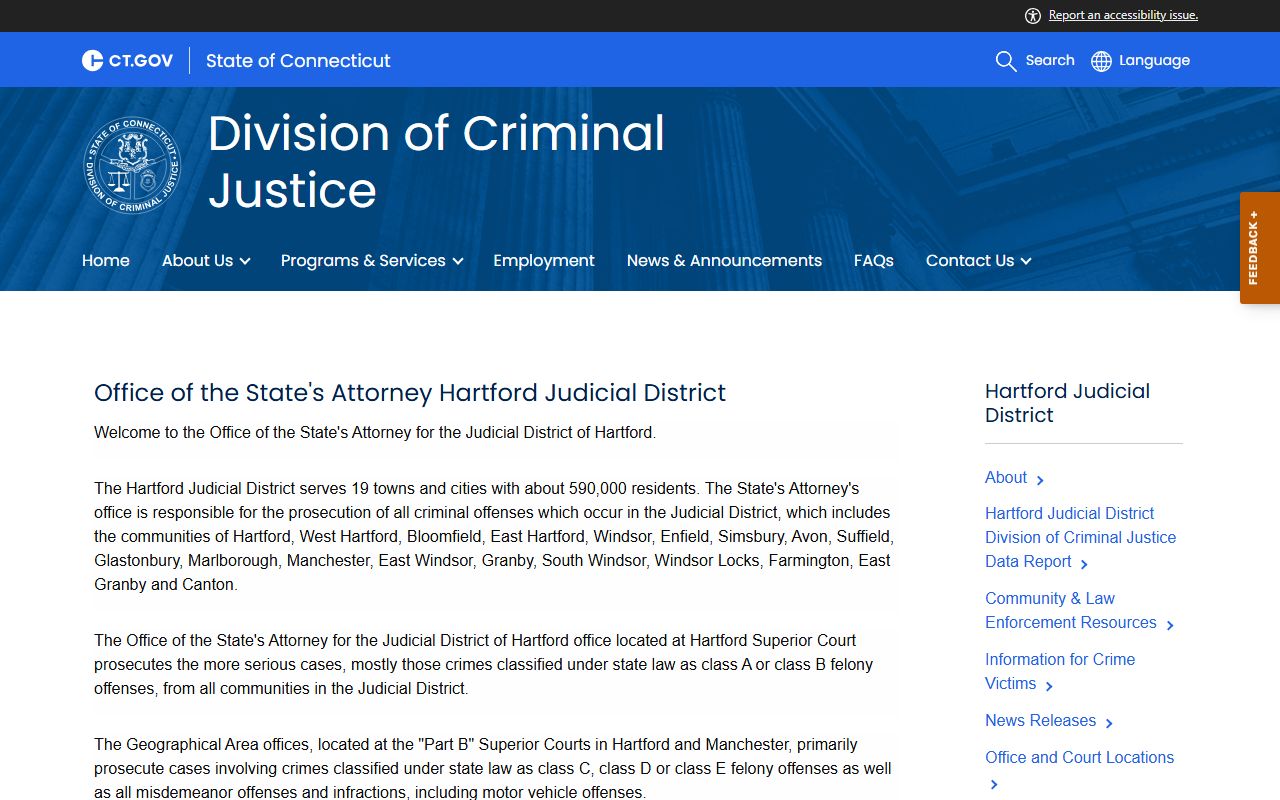
That page names the State's Attorney and lists the towns the office serves. When a Manchester arrest involves a high-level felony, the court record is most likely tracked through the Hartford Judicial District side.
Note: Manchester arrests can produce a court record at GA 12 or at Hartford Superior Court, depending on how serious the prosecutor's filed charge is.
Searching Connecticut Court Records After an Arrest
Court records after an arrest live in one main place. The Connecticut Judicial Branch runs a criminal and motor-vehicle case lookup. It is the official public search for pending and disposed cases. Booking and custody detail are not here. Those sit on the jail roster. The case lookup shows the filed charges, the docket, court dates, and the status of each charge. It is the right tool once charges are filed.
- Gather the person's exact name, date of birth, arrest date, and any docket or police case number from the arrest paperwork or the police Records Unit.
- Open the Judicial Branch criminal and motor-vehicle case lookup and search by defendant name or by docket number.
- Check whether the case sits in GA 12 Manchester or the Hartford Judicial District, since lesser cases run through the GA court and serious felonies run through Hartford.
- Compare the court-filed charges against the booking charges, because the court record controls the filed prosecution status, not the police booking sheet.
- Watch the status terms on each charge: pending, amended, reduced, dismissed, nolled, conviction, sentence, failure to appear, rearrest ordered, or sealed and erased.
The portal asks for a small set of fields, drawn from the Judicial Branch case lookup and its bulk-data document. Exact spelling helps, and a docket number is the fastest route when known.
| Field Label | Type | Required | Notes |
|---|---|---|---|
| Defendant Last Name | text | Yes for name search | Use exact spelling when possible. |
| Defendant First Name | text | Recommended | Narrows common names. |
| Date of Birth | date / text | Optional | Helps tell defendants apart. |
| Docket Number | text | Yes for docket search | Use the full docket number when known. |
| Court Location | dropdown | Optional | GA 12 Manchester or Hartford Judicial District. |
| Case Type | tab / link | Optional | Use the criminal / motor-vehicle lookup. |
| Search | button | n/a | Runs the case lookup. |
If the online case does not appear, the clerk is the next stop. Erased, sealed, juvenile, youthful-offender, and older limited-access matters may not show online. The official entry point is the Judicial Branch criminal and motor-vehicle case lookup. A paid bulk-data option also exists for pending cases and convictions, described in the Judicial Branch bulk criminal-case data document, though it does not include electronic documents.
Booking Charges vs Filed Charges
The charge on the booking sheet is not the final word. Police write a booking charge at the time of arrest. The State's Attorney then reviews the case and files the court charge. The two can match, but they often shift. A booking charge can be amended, reduced, dropped, or swapped for a different count. Only the filed charge becomes the court record that drives the case. Reading both sides keeps the picture accurate.
| Booking Charge | Filed Charge | |
|---|---|---|
| Created By | Manchester Police at arrest | State's Attorney |
| Where It Shows | Police arrest record | Court case lookup |
| Can Change | Yes, before filing | Yes, by amendment |
| Controls the Case | No | Yes |
One more point matters for families. Being held is not the same as being convicted. The Connecticut Department of Correction warns that current incarceration does not always mean conviction, because the state holds many people on accused status while they wait for trial.
| Charge | Conviction | |
|---|---|---|
| Stage | Accusation | Verdict or plea |
| Proof Needed | Probable cause | Beyond a reasonable doubt |
| Means Guilt | No | Yes |
| Public Record | Yes | Yes |
Charge Status and What It Means
A court record changes as the case moves. Each charge carries a status, and the words have set meanings. A charge can stay pending for months. It can be reduced to a lesser count. It can be dropped at the prosecutor's choice. Two terms confuse readers most. A nolle, short for nolle prosequi, means the prosecutor chose not to pursue the charge for now. A dismissal ends the charge outright. Knowing the term tells you where the case stands.
| Status | What It Means |
|---|---|
| Pending | The charge is open and the case is still moving through court. |
| Amended / Reduced | The charge was changed or lowered to a lesser count. |
| Dismissed | The charge was ended and will not go forward. |
| Nolled | The prosecutor chose not to pursue the charge, subject to erasure timing. |
| Conviction | A plea or verdict found the person guilty of the charge. |
| Failure to Appear | The defendant missed a required court date. |
| Rearrest Ordered | The court ordered a new arrest, often after a missed date. |
| Sealed / Erased | The record is restricted from public view under state law. |
These status terms are the heart of any court record search. A pending charge and a dismissed charge tell very different stories. When a status is unclear, the court clerk can confirm what the docket entry means.
Bond and Release After a Manchester Arrest
Bond decides whether a person waits for court in custody or at home. After a Manchester arrest, a release decision is made early. A person may be released on a written promise, on conditions, on a cash or surety bond, or held for court. Connecticut still licenses commercial bail. The Insurance Department licenses surety bail bond agents under C.G.S. section 38a-660. The Department of Emergency Services and Public Protection licenses professional bail bondsmen under sections 29-144 through 29-152.
| Bond Type | How It Works |
|---|---|
| Written Promise / Recognizance | Release on a promise to appear or on court-set conditions, with no money posted. |
| Cash Bond | The defendant or a payer deposits the full court-ordered amount. |
| Surety Bond | A licensed surety bail bond agent posts the bond through an insurer. |
| Professional Bail Bond | A licensed professional bondsman posts the bond backed by personal assets. |
| No-Bond Hold | Payment will not release the person until the hold is cleared. |
Posting bond takes a few careful steps. Rushing past them can waste money on a person who still will not be released.
- Find out whether the person is still with Manchester Police, in court, or in Department of Correction custody.
- Verify the bond amount and type from the arrest paperwork, the court case lookup, or the holding facility.
- Ask the responsible agency where payment is accepted, since police processing and jail custody can give different instructions.
- If using a bondsman, confirm the license through the official state channels for that bond type.
- Confirm there are no holds, because a paid bond will not free someone with a detainer or separate warrant.
The licensing rules are public. The Insurance Department explains agent licensing on its surety bail bond agent page, and DESPP outlines the two bondsman types on its bail bondsmen FAQ. A hold defeats a bond payment, so that check comes last and matters most.
Note: A bond paid in full will not release a person who also has a detainer, a parole hold, an extra warrant, or an immigration hold.
Warrants That Lead to an Arrest
Many arrests start with a warrant. Manchester does not publish a public warrant database. The police site lists unit phone lines but no warrant roster. So the court file, not a warrant list, is the practical place to spot a problem. Bench warrants and failure-to-appear orders usually attach to a Judicial Branch case record. Searching the case lookup by name can surface a pending matter or a rearrest order when it is public.
Warrants come in several forms, and each links to custody differently. An arrest warrant is judge-authorized on probable cause and can lead to booking and commitment. A bench warrant, or failure-to-appear, issues when a defendant misses court or breaks a court order. A search warrant authorizes a search, not custody, and its materials may stay limited while an investigation is open. A fugitive or rearrest warrant can trigger booking, a hold, or extradition for another jurisdiction.
The safe route is the court, not the front desk. Because no warrant portal exists, the clerk or an attorney is the right contact to verify a case and follow court instructions. Do not appear at a police station over a possible active warrant without understanding the custody risk. The Division of Criminal Justice does not provide criminal record checks to the public; it directs those requests to the Connecticut State Police, as noted on the DCJ criminal records page.
Erased Records and Restricted Cases
Connecticut does not use the words sealed and expunged the way many states do. It uses erasure. C.G.S. section 54-142a erases criminal records after a dismissal, a nolle that has aged past the statutory period, an acquittal, a decriminalized offense, or an absolute pardon. Once a record is erased, it leaves the public court lookup. So a charge that was dismissed last year may simply not appear in an online search today. That absence does not mean the arrest never happened. It means the law removed the record from public view.
Erasure also reaches the data resellers. Section 54-142e requires anyone who buys criminal public-record data to obtain erasure updates and delete erased records. The Judicial Branch bulk-data document repeats the duty: buyers must purchase updates on erased matters, delete erased records, and not pass them along. Juvenile arrests and Youthful Offender cases sit outside the normal public stream entirely. An online lookup will not show those, and it will not show records the law has already erased.
Connecticut erasure statutes.
- C.G.S. section 54-142a: erases criminal records after dismissals, aged nolles, acquittals, decriminalized offenses, and pardons.
- C.G.S. section 54-142e: makes data buyers update and delete erased criminal records they hold.
- C.G.S. section 54-142t: requires automated erasure processes and agency cooperation across the courts and corrections.
Note: An erased Connecticut case will not appear in the public court lookup, so a missing record is not proof that an arrest never occurred.
Criminal History Checks in Connecticut
The court lookup shows individual cases. A full criminal history is a different product. The Division of Criminal Justice says plainly that it does not provide criminal record information to the public. It points people to the Connecticut State Police for criminal record checks and letters of good conduct. So a single arrest case comes from the Judicial Branch lookup, while a statewide rap-sheet-style check runs through the State Police. The two answer different questions.
The state's open-records law sets the baseline for what is public. Connecticut's Freedom of Information Act, in Chapter 14, makes agency records public unless an exemption applies, and section 1-215 treats the record of an arrest as a public record from the time of arrest, with redactions for juveniles, erased material, and certain victim or witness detail. The statutes are posted in the Connecticut Freedom of Information Act chapter.
Important: Manchester County Inmate Population is not a consumer reporting agency under the FCRA, and nothing found through it may be used for credit, employment, tenant, or insurance screening.